
Online Safety
With the internet being such a big and important part of life in these times, it is essential that parents and children know how to keep safe online. The safety of our children is of paramount importance to us. Therefore, one thing we implement at the beginning of each academic year is for everyone to sign an 'Acceptable Use Policy', which parents also sign. This outlines our online expectations and guidelines. The children are supervised when they access the internet, which is heavily filtered using our filtering and monitoring system. The school network is also monitored, and the children are always encouraged to tell an adult or use the CEOP button if they have any concerns. Within computing lessons, children are also asked to sign to say that they have read and understood our child-friendly 'Online Safety Policy'.
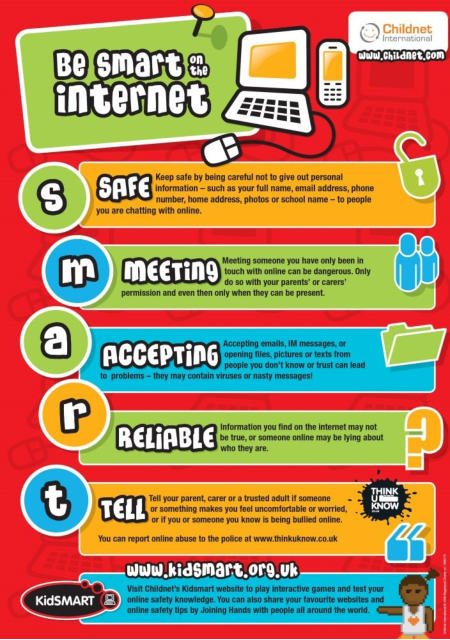
Online Safety in the school curriculum: Online safety is taught within the computing curriculum throughout the year, and we also celebrate the national 'Safer Internet Day' by partaking in numerous activities. The children also learn about the SMART rules for keeping safe online and these are displayed around school and in every classroom. As a school we also follow a scheme of work using Project Evolve to teach Online Safety. This is taught in a two-year cycle to accommodate our mixed-age classes.
These websites are used frequently in school with our children:
CEOP: The Child Exploitation and Online Protection Centre provides online support to children and parents on issues such as bullying, viruses, webcam/video chat use and photo distribution. Parents and children report specific online safety concerns here. You will also be able to find this CEOP link on our homepage.
Think U Know: Think U Know provides up-to-date information and activities to educate children and parents on how to stay safe online.
Internet Matters: Internet Matters provides accessible information on issues such as sexting, radicalisation, online grooming and your online reputation.
The 4 Cs of online safety | NSPCC Learning: An important step in improving online safety is identifying what the potential risks might be. Risks can be grouped into four areas: content, contact, conduct and commerce. These are known as the 4 Cs of online safety.
We understand that the internet is forever changing and apps are constantly being developed; as well as keeping our children safe in school, we also want to make sure they use the internet safely at home. Therefore, there are a series of useful links below with up-to-date information and guidance for parents:
- Please click this link to read the 'Digital Parenting' articles and advice.
- Please click this link for advice on online gaming.
- Please click this link for help and advice for families in a digital world.
- Please click this link for a useful guide on 'The use of Social Media'.
- Please click this link to access the SMART rules followed throughout school.
- Please click this link for top tips on 'Parental Controls'.
- Please click this link for information regarding 'Live Streaming'.
- Please click this link for advice on 'Sharing Pictures of your Children Online'.
