Phonics
Overview of the Subject:
Phonics is taught daily at Spire Junior School by staff who share a passion and knowledge for the subject. The enthusiasm and focus within the lessons is evident. The lessons themselves follow the government-approved systematic synthetic scheme Little Wandle. As we are a Junior School, our phonics scheme is only accessed by those in need of further phonics teaching and learning. Those children who have secured the foundational skills of reading access their age-appropriate spelling schemes during this allocated lesson time.
Systematic Synthetic Phonics is an evidence-based, structured approach to teaching children to read. This method of reading helps children to learn the relationships between the sounds (phonemes) of spoken language and the letter symbols (graphemes) of the written language. During our most recent Ofsted inspection, early reading was a focus:
‘There is a strong culture of reading at the school. Leaders ensure that there is a concentrated focus on reading from the moment that pupils join the school. There is a consistent approach to the teaching of phonics. If pupils fall behind, staff provide them with extra sessions so that they can catch up. Leaders make sure that the books pupils are given to read match the letters and sounds that they are learning. Pupils enjoy the opportunity to win books from the school’s book vending machine.’ Ofsted May 2022
Subject Information:
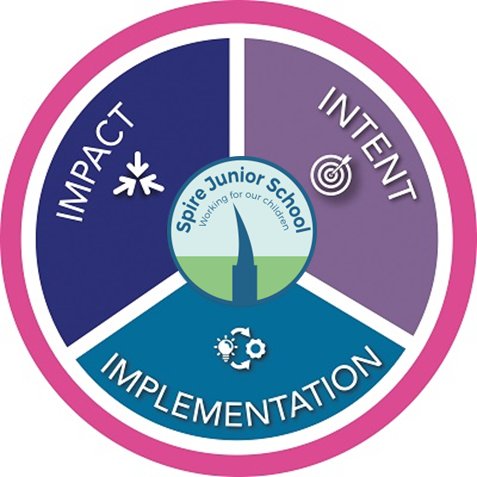
Intent:
At Spire Junior School, we are passionate about ensuring all children become confident and enthusiastic readers and writers. We believe that phonics provides the foundations of learning to make the development into fluent reading and writing easier. Through daily, systematic and consistent, high-quality phonics teaching, children learn to segment words to support their spelling ability and blend sounds to read words. To allow our children to develop a strong phonic awareness and effective blending and decoding skills, we have chosen to use a synthetic phonics programme called Little Wandle.
Implementation:
At Spire Junior School we use the Department of Education approved Little Wandle programme for our teaching of phonics. This KS2 Rapid catch up programme allows our phonics teaching and learning to be progressive from the fundamentals taught during Key Stage 1.
When the children start at Spire Junior School, we assess those children who did not pass the phonics screening to ensure we can meet their individual needs. Children are assessed at each level and against the sounds within those levels. From this they receive specific daily sessions that match children’s current knowledge and understanding whilst ensuring the children are suitably challenged. This support caters to their individual requirements. Children use phonetically decodable books matched to their phonics knowledge that focusses on the level/sound that they are learning and games to play to support them. This daily support is maintained throughout school, in all classes. Teachers regularly assess children’s phonics knowledge using the Little Wandle Assessment Portal. These regular assessments inform planning and allow teachers to identify any gaps in learning.
Books are chosen from our reading schemes – Big Catt, Oxford Reading Tree, Project X, Word Sparks, Snapdragons, Hero Academy, Tree Topsand.
Staff systematically teach learners the relationship between sounds and the written spelling patterns, or graphemes, which represent them. Staff ensure Phonics is an integrated part of all learning. Daily phonics is taught though level group input, differentiated activities for each group linked to the graphemes they are learning.
Impact:
Through the teaching of systematic phonics, our aim is for children to become fluent readers: pupils will be confident in their phonic knowledge; they will be able to blend and segment words confidently; pupils will learn to love reading through fun but challenging phonic activities; and we will create a culture where a secure knowledge of phonic sounds enables reading for pleasure as part of our reading curriculum. This way, children can focus on developing their fluency and comprehension as they move through school.
What do phonics lessons look like?
The scheme is taught over 6 sessions a week. Phonics lessons are 15 minutes long. Each phonics lesson includes the following elements:
• Revise – overlearn the previous graphemes and words
• Teach – introduce a new grapheme/words
• Practise – develop GPCs (grapheme phoneme correspondences)/read and spell new words
• Apply – use new graphemes/words in games and activities to secure knowledge
• Assess – monitor progress within each level to inform planning
Children read the same book aloud in each of the three sessions with growing automaticity and accuracy. The pre-read and independent reading parts of the sessions are essential in providing the repeated practice needed for children to build fluency.
Each session in this ‘three read’ model has a clear focus:
• Read 1: decoding
• Read 2: prosody – reading with meaning, stress and intonation
• Read 3: comprehension – understanding the text.
Each of these sessions follows the same structure:
• Pre-read: Revisit and review
• Reading practice: Practise and apply
• Review: Pacy review of any misconceptions
Key features of effective phonics practice Seven features of effective phonics practice
Through the English Hubs Programme, seven key features have been identified as characterising phonics teaching in highly successful schools, no matter which validated programme is being used.
These are:
• direct teaching in frequent, short bursts
• consistency of approach
• secure, systematic progression in phonics learning
• maintaining pace of learning
• providing repeated practice
• application of phonics using matched decodable books
• early identification of children at risk of falling behind, linked to the provision of effective keep-up support.
Long-term subject overview:
Individual phonics
Children who are still working on the phonics levels should be assessed and have books that relate to their specific sound/set. Individual phonics sessions should take place at least 3 times a week and cover the same process as the sessions (Revisit and Review, Teach, Practise, Apply). Individual sessions should allow time for specific/focused reading (decode, prosody, comprehension)
Phonics resources:
For parents | Letters and Sounds
For parents | Letters and Sounds